Gavin Newsom saying "What can I say? I just love traffic!"

Why does Gavin Newsom love traffic so much?

His reasons are his own, and we can only speculate as to what they are. All we can say for sure is that the Governor has set an arbitrary policy that will add thousands of additional cars to California's roadways.

The policy is a return to office (RTO) mandate that requires all California state workers to work onsite at least 4 days per week without operational need. Many state workers have worked effectively from home 5 days per week for over four years, and in so doing have defrayed significant costs to California's taxpayers and the environment.

Until the RTO mandate, 37% of state employees worked primarily from home.1 Gavin's return-to-office mandate will force an estimated 90,000 state workers on the roads throughout California; that means we can expect over 30,000 more cars in Sacramento and over 7,000 in Los Angeles during peak commuting hours.2

Read About the Environmental Costs

California is already failing to meet its climate goals,3 and over 25% of the most polluted cities in the country are located in California.4

From 2021-2023, state telework policies prevented nearly 400,000 metric tons of carbon from being released into the atmosphere due to daily commutes.5

Based on the most recent month of Department of General Services' Tracking Telework data, the Governor's mandate for state workers to report to office locations at least 4 days per week is estimated to create a minimum of about 178,000 metric tons of carbon dioxide emissions over the course of a year.
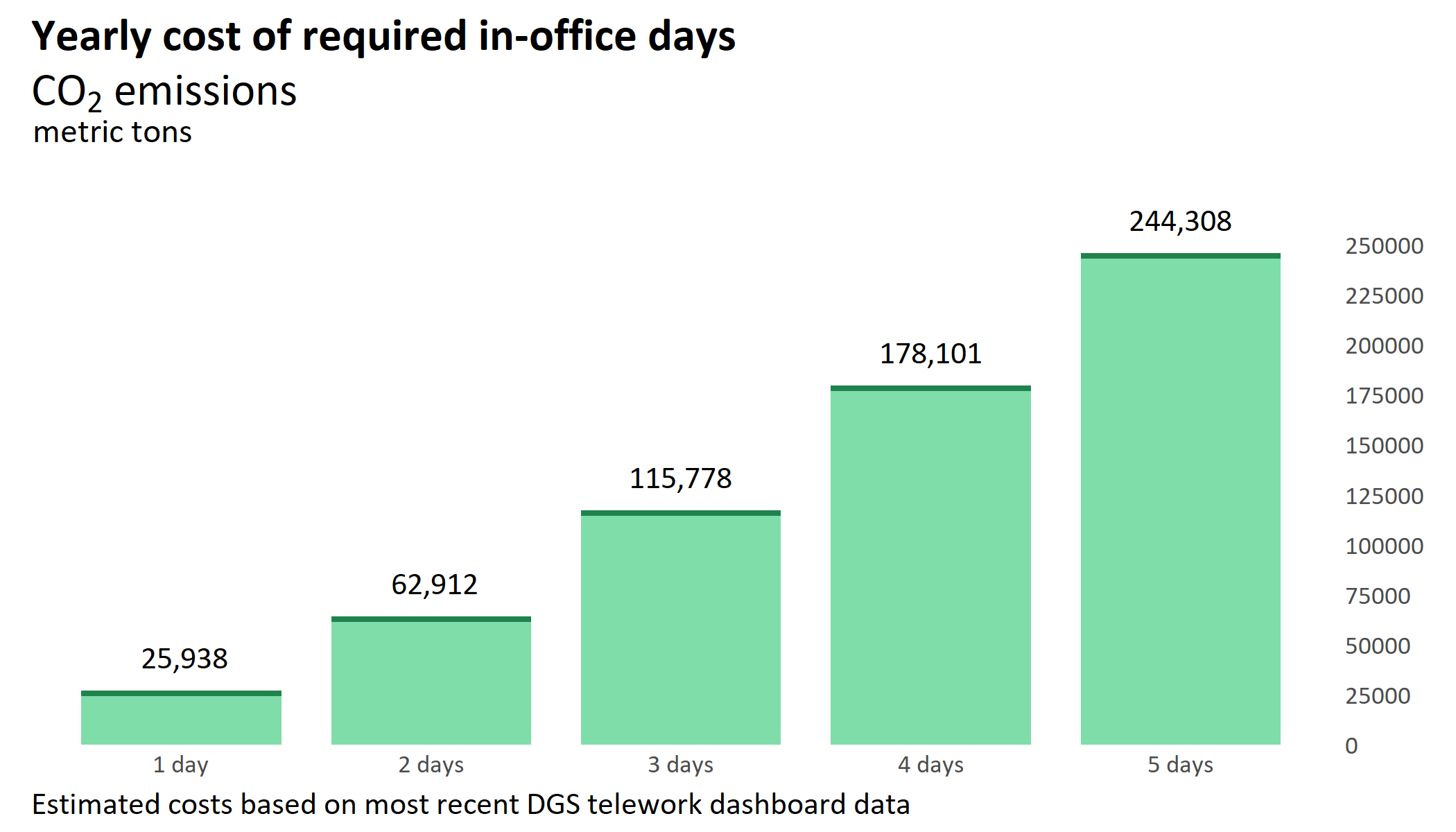
Bar graph showing how many CO2 emissions will be created over a year due to Gavin's love of traffic.
Figure 1. Estimated CO2 emissions in metric tons over the course of one year (y-axis) for each number of mandated days state workers are required to report onsite (x-axis).

Gavin failed to conduct an environmental impact assessment for the RTO policy as required by the California Environmental Quality Act.6 If he effectively ends telework for state workers by requiring employees to report to the office 5 days per week, the annual estimated CO2 emitted as a result of the policy could near 250 million metric tons.

Given the urgency of the climate emergency, we need to take as many measures as possible to prevent catastrophic climate change. Telework is one of many necessary tools in our toolkit to ward off climate change. California can't afford RTO.

Read About the Health Costs

Putting more cars on the road creates traffic, resulting in longer commute times.7 Gavin may love traffic, but more time spent in traffic means more exposure to hazardous pollutants: longer commute times are linked to higher individual dosage of chemicals identified as harmful in Proposition 65, such as benzene and formaldehyde.8

In addition to creating traffic, more cars on the road means there are more opportunities for collisions.9 Preventable deaths due to road injury have gone up in California over the past two decades,10 and there are motor vehicle crash hotspots near state office locations in Sacramento.11 California can't afford RTO.

Read About the Costs to Taxpayers

When more cars are on the road, pavement deteriorates more quickly, and roadways across California are already declining in quality.12 Sacramento roadways are no exception, and maintenance for road infrastructure in the city is critically underfunded.13 It will cost billions of dollars to fix the roadways, and taxpayers will foot the bill.12

Nearly half of state departments said state employees teleworking allowed them to reduce office space and save money on leases,14 and there were plans to turn some unneeded state offices into housing.15 A State Auditor's report estimated it would cost the state $225 million dollars per year to lease additional office space for the state to accommodate a 2 day in office requirement;16 the current 4 day policy is even more costly. California can't afford RTO.

Absent an operational reason to take 100% telework off the table for state employees, we can only assume that Gavin must love traffic, pollution, carbon emissions, and wasting everyone's time and money—or, at least, he must care more about making traffic worse than he does about meeting California's ambitious climate goals.

Help Gavin break up with traffic


References

  1. California Department of General Services. (2024, Feb 15). State Hybrid Workforce Dashboard: State Hybrid Workforce Trend. California Open Data Portal.
  2. State Controller Office. (2024, March). State Alphabetical listing of the active state employees by County. Retrieved April 29, 2024. Estimates obtained by multiplying the number of state workers by 37% (based on DGS State Hybrid Workforce Trend data).
  3. Lazo, A. (2024, March 14). California isn’t on track to meet its climate change mandates — and a new analysis says it’s not even close. CalMatters.
  4. American Lung Association. State of the Air: Most Polluted Cities. Retrieved April 27th, 2024.
  5. California Department of General Services. (2024, Feb 15). State Hybrid Workforce Dashboard: Benefits of Telework. Note: DGS sunsetted the dashboard on March 29, 2024, and the data is not available on the California Open Data Portal.
  6. Betulius, K. (2026, June 8). California union alleges CEQA violation in state's return-to-office policy. Davis Vanguard.
  7. Burrows, M., & Burd, C. (2024). Commuting in the United States: 2022. American Community Survey Briefs, ACSBR-018, U.S. Census Bureau: Washington, DC.
  8. Reddam, A., & Volz, D. C. (2021). Inhalation of two Prop 65-listed chemicals within vehicles may be associated with increased cancer risk. Environment international, 149, 106402.
  9. Elvik, R., Erke, A., & Christensen, P. (2009). Elementary units of exposure. Transportation Research Record: Journal of the Transportation Research Board, No. 2103. Transportation Research Board of the National Academics: Washington, DC.
  10. California Department of Public Health. (2024). California Community Burden of Disease Engine (CCB). Retrieved April 27th, 2024.
  11. Safe Transportation Research and Education Center, University of California, Berkeley. (2024). Transportation Injury Mapping System (TIMS).
  12. Save California Streets. (2023, April). California Statewide Local Streets and Roads Needs Assessment.
  13. City of Sacramento, Department of Public Works. (2022, August). Pavement Condition Report.
  14. Miller, M. (2024, March 29). California departments with return-to-office mandates praised telework in internal surveys. The Sacramento Bee.
  15. Macht, D. (2023, January 31). Gov. Newsom plans to convert EDD headquarters and 2 more downtown Sacramento office buildings into housing. KCRA
  16. California State Auditor. (2025, Aug. 12). 2024-118 State Telework Policies.